

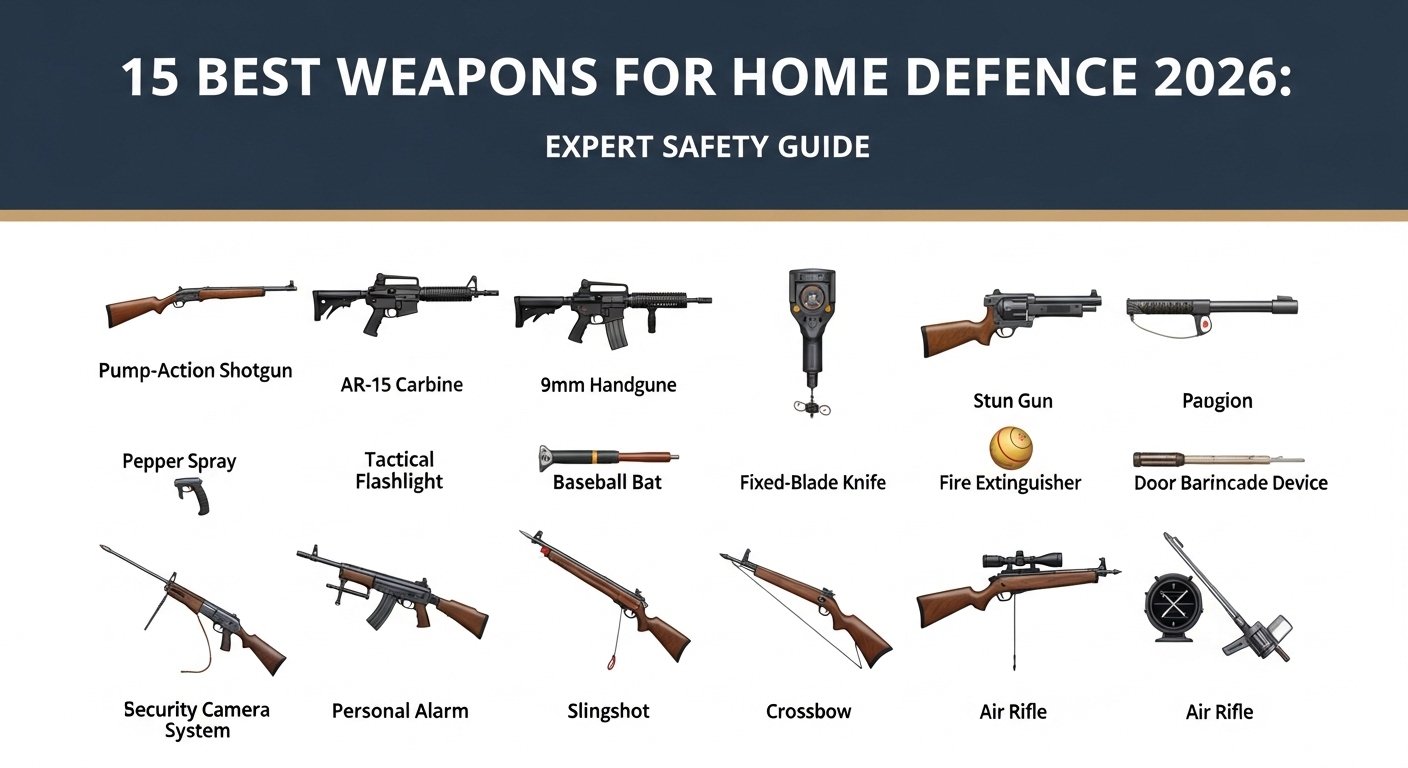
It’s 2 a.m. The house is quiet in that deep, almost sacred way that only the middle of the night can offer. Then comes a sound sharp, unfamiliar, and instantly unsettling. In moments like this, the idea of “home” shifts from comfort to responsibility. Protecting what matters most becomes instinctive. Yet in 2026, the conversation around Weapons for Home Defence has evolved far beyond raw firepower. It now sits at the intersection of safety, legality, technology, and judgment.
For modern homeowners especially entrepreneurs and professionals who value both security and control the question is no longer just what works, but what works responsibly. The best choices are those that balance effectiveness with restraint, ensuring protection without escalating risk unnecessarily.
The Modern Context of Home Defence
Home defence today reflects a broader shift in how society approaches safety. Urban density, smart home technology, and evolving legal frameworks have reshaped the landscape. What once centered heavily on traditional firearms now includes a wider spectrum of tools some designed to deter, others to incapacitate, and many to alert or delay.
This shift matters because the primary goal of home defence is not confrontation it’s prevention. A well-secured home discourages intrusion long before any weapon becomes relevant. The tools discussed in this space should always be viewed as a last line of defense, not the first.
Rethinking “Weapons for Home Defence” in 2026
The phrase itself can be misleading. It implies aggression when the real objective is control. Effective home defence tools are less about combat and more about creating time, space, and options.
In 2026, the most respected security experts emphasize layered protection. This includes environmental awareness, reinforced entry points, surveillance, and only when necessary defensive tools that can be deployed safely under pressure.
Understanding this layered approach reframes how we evaluate different options.
Non-Lethal Solutions: The First Line of Responsible Defence
One of the most significant trends in home security is the rise of non-lethal defensive tools. These options appeal to homeowners who want protection without the irreversible consequences associated with lethal force.
Devices designed to temporarily disorient or incapacitate an intruder such as high-intensity deterrents or chemical-based sprays have become more sophisticated and reliable. Their appeal lies in their ability to stop a threat without permanently harming someone, which aligns with both ethical considerations and legal realities in many regions.
Equally important is accessibility. Non-lethal tools are generally easier to store, require less training, and present fewer long-term risks when compared to more aggressive alternatives.
Firearms and the Weight of Responsibility
Despite the growing popularity of non-lethal tools, firearms remain part of the conversation around Weapons for Home Defence. For some homeowners, they represent the ultimate form of protection. However, their presence introduces a level of responsibility that cannot be overstated.
Ownership requires not only legal compliance but also disciplined training, secure storage, and emotional readiness. In high-stress situations, decision-making can become impaired. This is why experts consistently stress that a firearm is only as safe as the person handling it.
In 2026, smart storage solutions biometric safes, for instance have become integral to responsible ownership. These systems ensure quick access for authorized users while preventing accidents or misuse.
The Role of Smart Technology in Defence
Technology has quietly become one of the most powerful “weapons” in home defence, even if it doesn’t fit the traditional definition. Smart systems now act as both deterrents and early warning mechanisms.
Motion sensors, AI-powered cameras, and automated lighting create environments where intruders are less likely to act. The knowledge that a property is actively monitored can be enough to redirect potential threats elsewhere.
More advanced systems integrate with mobile devices, allowing homeowners to assess situations in real time even when they’re not physically present. This shift from reactive to proactive security changes the entire dynamic of home protection.
Psychological Deterrence: The Invisible Advantage
Not all defence tools are physical. Some operate on perception. Visible security measures cameras, alarm signage, reinforced doors send a clear message: this home is not an easy target.
In many cases, this psychological barrier is more effective than any physical response. Intruders typically seek opportunity, not confrontation. When risk appears high, they move on.
This is why seasoned security professionals often argue that the best defence is one that never needs to be used.
Legal Awareness: A Non-Negotiable Factor
Any discussion of Weapons for Home Defence must include legal context. Laws vary widely across regions, influencing what tools are permitted, how they can be used, and under what circumstances force is justified.
Ignorance in this area can have serious consequences. What may seem like a reasonable defensive action could be interpreted differently under the law. Responsible homeowners take the time to understand these boundaries and ensure their choices align with local regulations.
Legal awareness is not just about compliance it’s about protecting yourself from unintended outcomes.
Training and Preparedness: The Real Equalizer
Possessing a defensive tool without proper training is a risk in itself. In high-pressure situations, familiarity and muscle memory often determine outcomes.
Training doesn’t necessarily mean formal certification, though that can be valuable. It can also involve scenario planning, understanding response protocols, and ensuring that everyone in the household knows what to do during an emergency.
Preparedness extends beyond tools. It includes communication, coordination, and clarity under stress.
Balancing Security and Everyday Life
One of the subtle challenges of home defence is maintaining a sense of normalcy. A home should feel safe, not fortified to the point of anxiety.
This balance is especially important for families and professionals who value both security and quality of life. Over-reliance on aggressive measures can create an atmosphere of tension, while under-preparation leaves vulnerabilities exposed.
The most effective approach lies somewhere in between where security is present but unobtrusive, ready but not overwhelming.
Ethical Considerations in Home Defence
There is also a moral dimension to consider. The use of force, even in self-defense, carries weight. Decisions made in seconds can have lasting consequences.
This is why many experts advocate for restraint and de-escalation wherever possible. The goal is always to protect life yours and others while minimizing harm.
Ethics, in this context, are not abstract ideals. They are practical guidelines that shape how decisions are made under pressure.
The Evolution of Defensive Tools
Looking ahead, the category of Weapons for Home Defence will likely continue to evolve. Innovations in non-lethal technology, AI-driven security systems, and integrated home ecosystems are redefining what protection looks like.
Future tools may rely less on direct confrontation and more on prevention, automation, and intelligent response systems. This shift aligns with a broader societal move toward smarter, more humane approaches to safety.
Choosing What Works for You
There is no universal answer when it comes to home defence. The right approach depends on factors such as location, lifestyle, legal environment, and personal comfort level.
For some, a layered system centered on technology and deterrence may be sufficient. For others, additional defensive tools provide peace of mind. What matters is that each choice is informed, responsible, and aligned with the realities of modern living.
Conclusion
The idea of Weapons for Home Defence in 2026 is no longer defined by force alone. It is shaped by awareness, technology, and a deeper understanding of what it means to protect a home.
True security is not about preparing for the worst it’s about reducing the chances of it ever happening. The most effective defence is one that combines intelligence with restraint, ensuring that safety does not come at the cost of peace of mind.
In the end, protecting your home is less about what you hold in your hands and more about how thoughtfully you prepare for the moments that matter.