

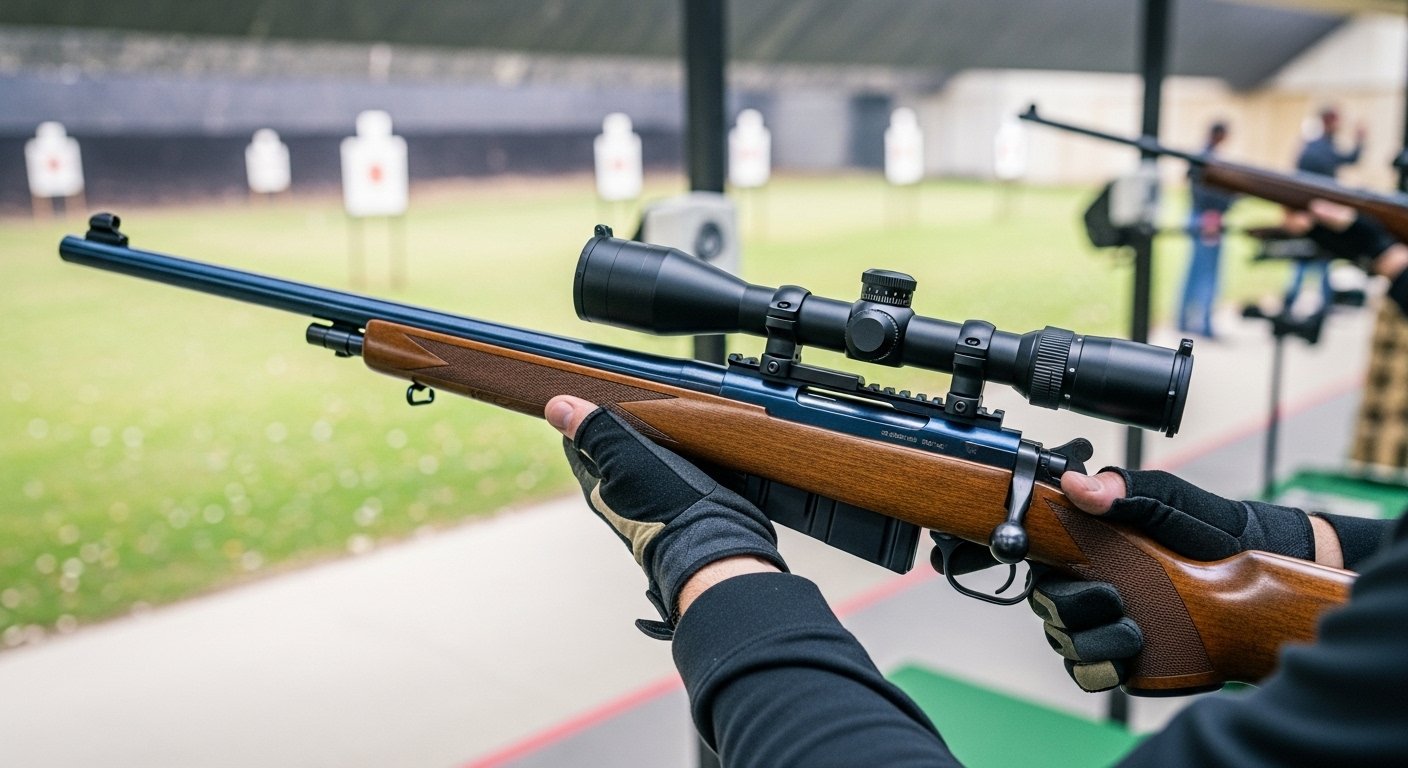
The first time many shooters encounter a Ranch Rifle, it rarely happens at a tactical range or inside a high-tech training facility. It happens on open land. A pickup truck parked near a fence line. Early light stretching across fields. A rifle resting casually beside someone who values reliability more than hype. That quiet introduction explains why the Ranch Rifle concept has endured for decades. It was never built to chase trends. It was built to work.
Few firearms represent that philosophy better than the Ruger Mini-14 Ranch Rifle. Since its introduction, the rifle has occupied a unique space between sporting tradition and modern practicality. While entire industries shifted toward tactical styling and modular platforms, the Mini-14 continued to appeal to ranchers, outdoorsmen, collectors, and professionals who appreciate simplicity paired with dependable performance.
This review explores why the Ranch Rifle remains relevant today, how it earned its reputation, and why many experienced shooters still reach for it despite an increasingly crowded rifle market.
The Origin of the Ranch Rifle Concept
To understand the Mini-14, it helps to understand the environment that shaped it. During the 1970s, American firearm manufacturers recognized a need for a lightweight semi-automatic rifle suited to everyday rural use. Farmers and landowners wanted something more versatile than a traditional bolt-action but less militaristic in appearance than emerging tactical rifles.
Ruger responded by developing a rifle inspired by the proven operating system of the M1 Garand and its descendant, the M14 rifle. The result was compact, durable, and familiar to shooters accustomed to classic American rifle ergonomics.
The Ranch Rifle designation later emerged as a refined version designed to accommodate optics while maintaining traditional handling characteristics. Instead of reinventing the wheel, Ruger refined a formula centered on reliability and balance. The idea was simple: a rifle that could live behind a truck seat, handle pests, protect livestock, and still deliver accurate shots when needed.
Design Philosophy: Practical Over Tactical
Modern rifle discussions often revolve around customization, accessories, and aggressive styling. The Mini-14 takes a different approach. Its design philosophy prioritizes function without distraction. At first glance, the rifle resembles a traditional sporting firearm rather than a modern tactical platform. The slim profile, classic stock options, and straightforward controls make it approachable for new shooters while remaining familiar to veterans.
The Ranch Rifle configuration introduced integral scope mounts and Ruger’s proprietary rings, allowing users to add optics without complicated modifications. This decision reflected real-world use cases rather than marketing trends. Ranchers and hunters wanted optics capability, not endless accessory rails.
The rifle’s rotating bolt and gas-operated action contribute to smooth cycling under varied conditions. Dust, temperature changes, and extended use rarely compromise performance. That consistency helped build trust among users who depend on equipment daily.
Handling and Ergonomics in the Field
One of the defining strengths of the Ranch Rifle is how naturally it handles. The balance point sits comfortably between the hands, making offhand shooting intuitive. Unlike heavier tactical rifles, the Mini-14 feels lively. Quick target acquisition becomes second nature, particularly in dynamic environments such as varmint control or property defense.
The safety placement inside the trigger guard echoes earlier American service rifles, allowing instinctive manipulation without shifting grip. For experienced shooters, muscle memory develops quickly. Recoil remains manageable due to the rifle’s gas system and weight distribution. Follow-up shots are smooth rather than abrupt, contributing to confidence during extended shooting sessions. Many owners describe the experience less as operating equipment and more as using a trusted tool.
Accuracy Expectations and Real-World Performance
Accuracy discussions surrounding the Mini-14 have evolved significantly over time. Early models earned mixed reputations, but modern manufacturing improvements dramatically enhanced consistency. Today’s Ranch Rifle typically delivers practical accuracy suitable for its intended role. It may not compete with specialized precision platforms, yet that comparison misunderstands the rifle’s purpose.
Where the Mini-14 excels is dependable field accuracy. Within common engagement distances, it performs reliably for pest control, recreational shooting, and defensive applications. Barrel improvements, tighter tolerances, and updated production methods helped Ruger refine performance without sacrificing durability.
For many shooters, the question is not whether the rifle can produce competition-level groups, but whether it performs consistently when conditions are imperfect. In that respect, it continues to succeed.
Ranch Rifle vs Modern Sporting Rifles
The rise of modular rifles reshaped consumer expectations. Adjustable stocks, interchangeable parts, and extensive accessory ecosystems became standard features.
Yet the Mini-14 persists because it offers something increasingly rare: simplicity.
| Feature | Ranch Rifle (Mini-14) | Modern Modular Rifle |
|---|---|---|
| Design Philosophy | Traditional utility | Tactical customization |
| Maintenance | Straightforward | Component-dependent |
| Weight Balance | Lightweight and natural | Often front-heavy |
| Appearance | Sporting rifle aesthetic | Military-inspired |
| Customization | Limited but functional | Extensive options |
| Intended Use | Practical field work | Multi-role adaptability |
This comparison highlights why the Ranch Rifle remains attractive to a specific audience. Not every shooter wants endless configuration choices. Many prefer a rifle that works well immediately without adjustment.
Reliability: The Core of Its Reputation
Reliability defines the Mini-14’s legacy more than any other characteristic. The fixed-piston gas system runs clean and consistently. The rifle tolerates varied ammunition types and environmental conditions without frequent maintenance demands. For ranchers working long days outdoors, this reliability matters more than theoretical performance metrics.
Stories from longtime owners often share a common theme: the rifle simply keeps running. This dependable operation helped establish the Mini-14 as a practical working rifle rather than a range novelty. It earned loyalty through years of real-world service rather than marketing campaigns.
Optics Integration and Modern Adaptability
While rooted in tradition, the Ranch Rifle adapted quietly to modern shooting trends. Integrated scope mounts made optics installation straightforward long before optics-ready designs became standard across the industry.
Today, owners commonly pair the rifle with low-power variable optics or red-dot sights, expanding versatility without changing its character.
This adaptability explains why the Mini-14 bridges generations of shooters. Older users appreciate its familiarity, while newer shooters value its ease of use and manageable learning curve. Rather than resisting modernization, the Ranch Rifle absorbs it selectively.
Cultural Influence and Media Recognition
Beyond technical specifications, the Mini-14 achieved notable cultural visibility. Television appearances and cinematic use introduced the rifle to audiences who may never have visited a ranch or shooting range.
Its distinctive silhouette became recognizable without appearing overly aggressive. That balance helped shape public perception of semi-automatic sporting rifles during decades of evolving firearm discussions.
Cultural presence alone does not sustain a product for generations, but it reinforces the identity already built through practical performance.
Ownership Experience and Maintenance
Owning a Ranch Rifle tends to be uncomplicated. Disassembly follows logical mechanical principles, and routine cleaning requires minimal specialized tools.
The rifle’s robust construction tolerates long intervals between maintenance sessions. For owners who prioritize usability over constant tuning, this is a significant advantage. Replacement parts and magazines remain widely available, supporting long-term ownership. Many Mini-14 rifles remain in active use after decades, passed between family members or retained as dependable utility firearms.
That longevity speaks to thoughtful engineering rather than temporary popularity.
Who the Ranch Rifle Is Really For
Not every firearm suits every shooter, and the Ranch Rifle succeeds because it embraces a clear identity. It appeals to individuals who value reliability, simplicity, and traditional design language. Ranchers, landowners, recreational shooters, and collectors often gravitate toward it for different reasons, yet they share appreciation for practical function.
Entrepreneurs and professionals entering shooting sports frequently find the Mini-14 approachable. Its controls feel intuitive, its appearance less intimidating, and its operation straightforward. In an era defined by specialization, the Ranch Rifle remains refreshingly general-purpose.
The Enduring Appeal of Classic Engineering
Technological progress often encourages replacement rather than refinement. New platforms promise innovation, yet many eventually rediscover lessons embedded in older designs.
The Mini-14 demonstrates that evolution does not always mean radical change. Ruger refined manufacturing, improved accuracy, and updated features while preserving the original concept.
Classic engineering endures because it solves real problems efficiently. The Ranch Rifle continues to embody that principle. It is not attempting to be everything. It is simply attempting to be reliable, balanced, and useful.
Market Relevance in a Modern Era
Today’s firearm market offers unprecedented variety. Buyers can choose highly specialized rifles tailored to niche applications.
Despite this competition, the Ranch Rifle maintains steady demand. Its continued production reflects sustained interest rather than nostalgia alone. Many shooters discover that after exploring highly configurable platforms, they still appreciate a rifle requiring little adjustment or explanation.
The Mini-14 occupies a middle ground rarely filled by modern designs: traditional yet semi-automatic, practical yet versatile, classic yet relevant.
Why the Ruger Mini-14 Still Matters
The enduring success of the Ranch Rifle is not accidental. It reflects decades of consistent performance aligned with real-world needs. Where some rifles excel only under ideal conditions, the Mini-14 thrives in ordinary ones. That distinction matters more than headline specifications.
Its continued popularity reveals something broader about firearm ownership and technology adoption. Innovation attracts attention, but reliability earns loyalty. The Ranch Rifle represents a philosophy that tools should serve people quietly and effectively. It does not demand constant upgrades or adjustments. Instead, it invites long-term familiarity.
Conclusion: A Rifle Built for the Long View
The Ruger Mini-14 Ranch Rifle endures because it understands its purpose. It was never designed to dominate competition circuits or chase tactical trends. It was designed to work, day after day, in the hands of ordinary users solving practical problems.
In many ways, the Ranch Rifle mirrors successful businesses and enduring technologies. Longevity comes from reliability, adaptability, and trust built over time. As the firearm landscape continues to evolve, the Mini-14 remains a reminder that progress does not always replace tradition. Sometimes it simply confirms that the original idea was right all along. The Ranch Rifle is not just a classic because it is old. It is a classic because it still makes sense.